
The Formless Self
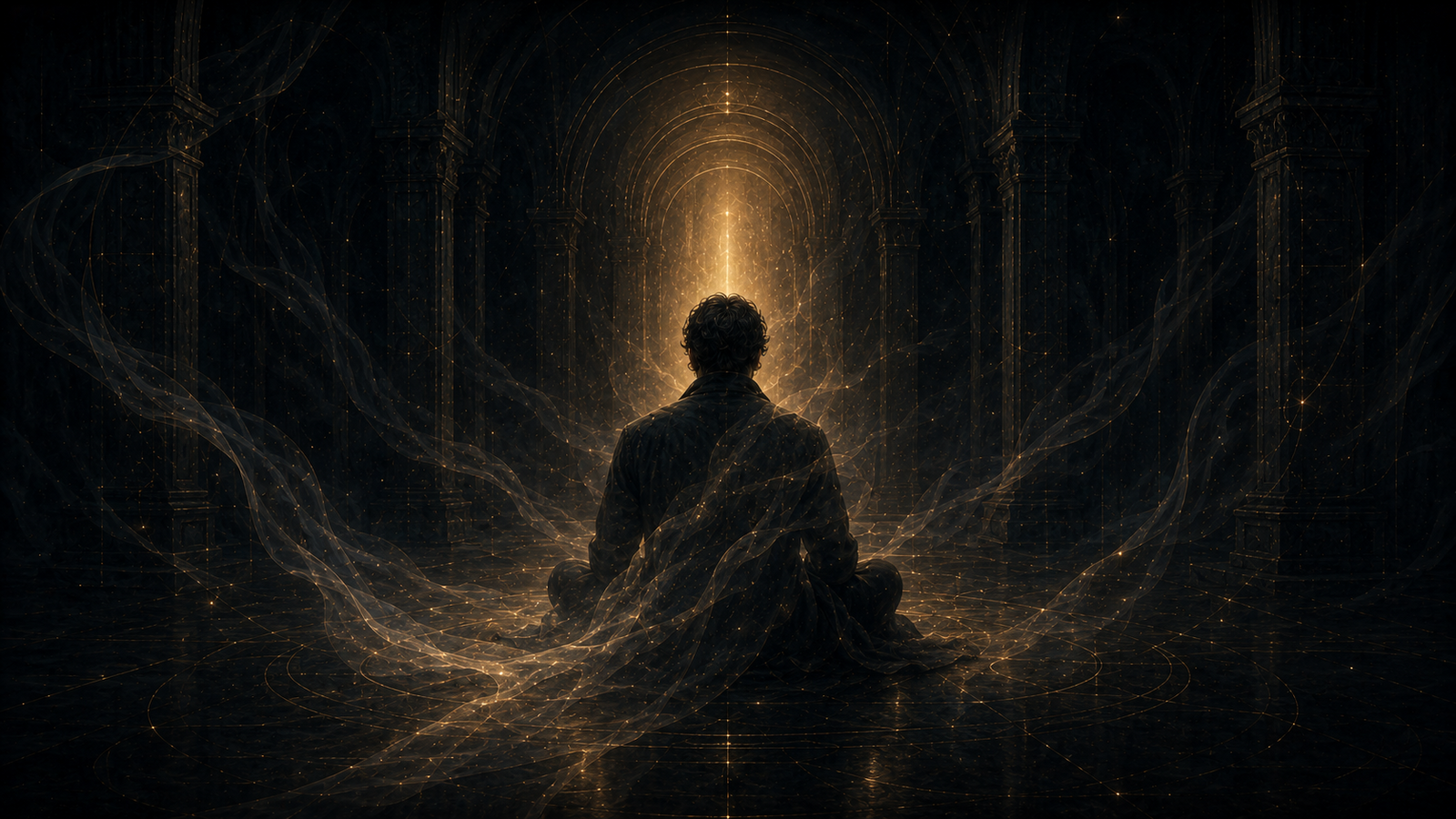
Most of the day is spent inside hard edges.
The room has walls. The clock divides one hour from the next. A name separates you from everyone who does not carry it. Even the body appears to end cleanly at the skin. We move among these edges until they seem less like a way of organizing experience and more like the final structure of reality.
Veilurgy begins by questioning that certainty.
It does not ask us to despise form. The body, the room, the name, and the ordinary world all matter. They are where we begin, and they are where we return. But they may not be the whole of what we are. The person sitting in a chair is also the awareness that knows the chair, the room, the memories, and the name. When attention is released from those things for a little while, something less easily defined remains.
I call that the formless self.
The meditation below is meant to help you approach it. It is not a test, and it does not promise a crossing. In Veilurgy, belief opens what force cannot. Straining for a result usually brings the walls of the ordinary world closer. For this reason, the purpose of the meditation is simply to become quiet enough to notice what remains when you stop holding yourself together so tightly.
Do not perform this meditation while driving or while doing anything that requires your attention. Sit or lie somewhere safe. If the practice becomes uncomfortable, open your eyes, look around the room, and let the exercise end. There is no value in forcing it.
Set down the reason you came
Before you begin, notice what brought you here.
Perhaps you want an answer. Perhaps you want relief, money, love, certainty, or some evidence that there is more to the world than what you have been shown. There is nothing shameful in any of that. Most people begin looking because something in their lives feels unfinished.
For the length of this meditation, however, set that reason down.
Imagine placing it beside you as though it were an object you had carried into the room. You are not destroying it. You are not pretending that it never mattered. You are only refusing to carry it through every door.
This is an important part of Veilurgy. Wanting has weight. A desire held too tightly does more than point toward an outcome. It fills the mind with the experience of not having that outcome. If a crossing follows where the mind dwells, then grasping may lead us toward a world shaped by absence.
Let the crossing itself be enough for now.
Enter the breath
Close your eyes if that feels comfortable.
Take a slow breath without trying to make it especially deep. Feel the body receive it. Then release it without pushing.
Take another.
Notice where the day has remained in you. It may be held in the jaw, the shoulders, the hands, the stomach, or somewhere harder to name. Do not command that place to relax. Bring the breath near it and give it room.
With every inhalation, feel that you are making space.
With every exhalation, let something become less important.
The unfinished conversation can wait. The work can wait. The person you were trying to impress can wait. The version of yourself you were trying to defend can wait.
Nothing has to be solved in this room.
Continue until the breath is no longer something you are doing correctly or incorrectly. Let it become a quiet movement that the body already knows.
Release the name
Bring your name to mind.
Hear it inwardly once. Notice everything gathered around it: your history, your roles, your failures, your responsibilities, the things people expect from you, and the things you expect from yourself.
Then let the name grow quiet.
You do not need to erase it. Simply stop answering it for a few minutes.
Beneath the name is the one who hears it.
Who is that?
Do not hurry to answer. Every answer will probably be another name, role, belief, memory, or description. Let each answer pass. The question matters more than the explanation.
Who is aware before the description arrives?
Rest there.
Let the room lose its edges
Notice the space immediately around your body.
You may still feel the chair, the floor, the blanket, or the air against your skin. Allow those sensations to remain. Formlessness is not reached by fighting form. It appears when form is no longer treated as a prison.
Imagine that the boundary between your body and the room has become less certain. You do not need to see light or create an elaborate scene. Simply consider the possibility that awareness is not sealed inside the skull.
Listen to the farthest sound you can hear.
Then listen to the silence around that sound.
Feel the space beyond your hands. Feel the space beyond your feet. Let attention extend without deciding where it must stop.
The room remains, but it no longer contains the whole of you.
If an image comes, allow it. If nothing comes, allow that too. Veilurgy does not depend upon manufacturing visions. An empty darkness honestly encountered is more useful than a spectacular world built through effort.
Dwell in wonder
At this point the mind may begin checking.
Is something happening? Am I close? Is this only imagination?
Let those questions pass through without answering them. They belong to the part of us that stands at a doorway and repeatedly turns around to make sure the old room is still there.
Choose wonder instead.
Wonder is not the same as expectation. Expectation tells the unknown what it must become. Wonder permits it to remain unknown long enough to reveal its own shape.
Hold one quiet thought:
There may be more here than I have been taught to notice.
Do not repeat it like a command. Let it rest in you as a possibility.
In Veilurgy, belief is not loud. It does not need to win an argument. Belief is the direction in which the mind leans when no one is watching. Let it lean, gently, toward the possibility of another shore.
You do not need to cross today.
You only need to stop insisting that the shore cannot exist.
Remain here for as long as the stillness feels natural. Let awareness be wider than the story you brought into the room. Let the body breathe inside that wider field.
Return with something you did not carry in
When you are ready, bring your attention back toward the body.
Notice your hands first. Feel their weight, temperature, and position. Move the fingers slightly.
Notice your feet. Press them gently into the floor or the surface beneath you.
Take one fuller breath.
Listen again to the room, not as an interruption, but as a place you have chosen to reenter.
Bring your name back. Let it settle around you without becoming the whole of you. The name is useful. The roles are useful. Form is useful. You can wear them without mistaking them for your entire being.
Open your eyes.
Name three objects you can see. Notice their color and shape. Give the ordinary world a moment of complete attention.
This final movement matters. A practice that only teaches us to escape form leaves half the work unfinished. Veilurgy concerns crossing and return. Whatever is encountered beyond the familiar must eventually be carried back into the life that seemed so solid before.
What returns may be subtle. You may feel a little more spacious. A thought that seemed urgent may have lost some of its authority. The room may look exactly the same while your place within it feels different.
Do not demand more.
Belief grows through repeated contact, not through the pressure to produce wonders on schedule. Perform the meditation again on another day. Let it become a known road. Notice what remains consistent, what changes, and what appears only when you stop looking for it.
The purpose is not to vanish.
It is to discover that you can loosen your hold on the world, touch something beyond its edges, and still return fully to the ground beneath your feet.
That movement, outward and home again, is where the work begins.
Say what you have seen, or ask what you need to ask. I read all of it.