
The Mirror Cannot Tell You Who You Are
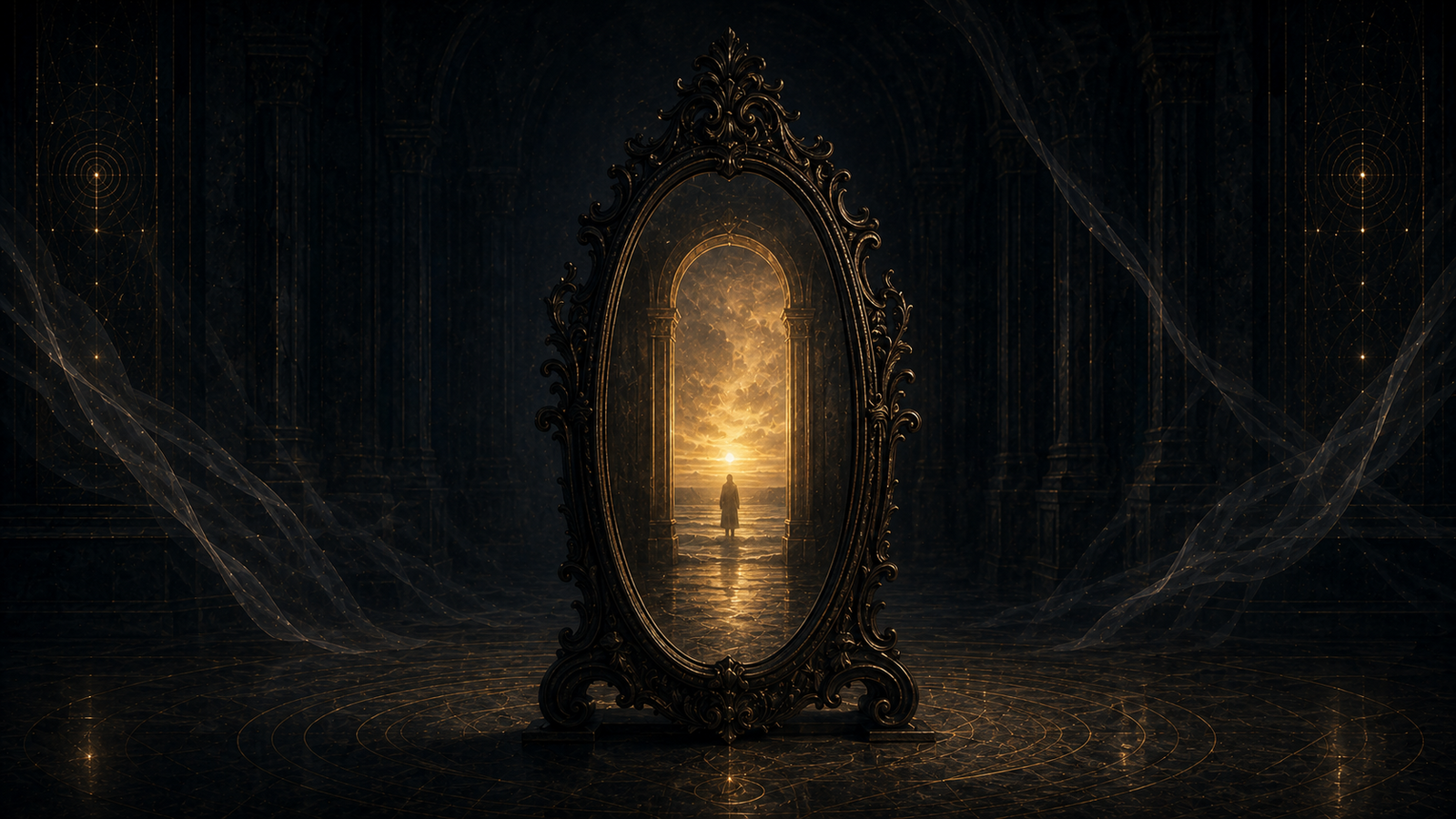
A mirror can show you a face, but it cannot tell you who is looking.
This seems obvious until we notice how often the outer world is asked to perform exactly that task.
We look at another person's approval and ask whether we are worthy. We look at a bank balance and ask whether we are secure. We look at attention, praise, invitations, messages, sales, followers, and signs, then use them to decide what is true within us.
Even spiritual practice can become another mirror.
Did the ritual work? Did the meditation feel powerful enough? Did something happen immediately afterward? Did the world provide evidence that we were heard?
The question beneath all of these questions is often the same:
Am I allowed to believe this yet?
Veilurgy places belief before the mirror.
That does not mean ignoring reality or pretending that circumstances do not matter. A mirror is useful precisely because it reflects something real. The problem begins when we expect the reflection to produce the person standing before it.
The endless search for a confirming world
There is a familiar cycle in manifestation practice.
A person forms an intention. For a while, they feel it clearly. Then they look outward to see whether anything has changed.
Perhaps a promising sign appears. Confidence rises. A day later the evidence disappears, and confidence collapses. The person returns to affirmations, visualization, or some other practice to rebuild the state, then checks the world again.
The outer world becomes an instrument that measures belief.
Unfortunately, the measurement also controls it.
Every check says, "The truth is still out there. I will know what I am when the world tells me."
This gives the mirror authority over the source.
Veilurgy begins from a different arrangement. Thought does not merely react to a finished world. Thought participates in the world that can be reached. Belief gives thought its direction, while doubt narrows the passage.
If belief is continually surrendered to appearances, it never becomes strong enough to reveal what lies beyond them.
The veil remains thick because the visible world has been granted the final word.
Reflection is not origin
Other people do reflect parts of us.
Someone may recognize a quality we have ignored. A relationship can reveal where we are generous, frightened, controlling, patient, or closed. The world often shows us patterns too near to be seen directly.
But a reflection remains partial.
It depends upon the angle, the light, and the surface. A warped mirror can return a warped image without changing the object before it. A person can misunderstand you sincerely. An institution can fail to value what it was never built to recognize. A crowd can reward a performance and overlook the life beneath it.
When external validation is treated as identity, we become trapped between mirrors.
One room tells us we are intelligent. Another makes us feel foolish. One person sees courage. Another sees arrogance. One season produces evidence of abundance. Another appears to withdraw it.
Which reflection is the truth?
None is complete enough to carry that weight.
The self that crosses the veil cannot be assembled from other people's reactions. It must be present before those reactions arrive.
The hidden cost of signs
Many people ask for signs because they want reassurance. This is understandable. Uncertainty can be exhausting, and a meaningful coincidence may offer genuine encouragement.
The danger lies in making signs into permission.
Once a sign has been appointed to validate belief, its absence can invalidate it. The person begins living from one appearance to the next. A bird, number, dream, message, or unexpected event is no longer received with wonder. It is interrogated.
"Does this mean I am close?"
"Does this mean the path is right?"
"Does this mean I can believe?"
The sign becomes another mirror, and the world behind the sign is never entered.
In Veilurgy, wonder is a cleaner guide than demand. Wonder can notice a pattern without requiring it to prove anything. It allows an event to remain strange. Demand reduces every mystery to a status report about the thing we want.
When that happens, even the sacred becomes a tracking system for desire.
Feel it as finished, then leave it alone
This is one of the hardest parts of manifestation, and it points directly toward the deeper work of Veilurgy.
Feeling something as finished is not the same as pretending it has appeared. It is the temporary release of the inward reaching that declares it absent.
For a moment, you stop asking the mirror.
You allow the desired state to exist within you without forcing the outer world to confirm it immediately. Then you leave it alone.
The second part is often harder than the first.
People can enter a state briefly. Remaining there without checking requires a different kind of trust. It means allowing the seed to remain underground instead of digging it up each morning to see whether it has changed.
Feel it as finished. Then leave it alone.
Everything after that is the world catching up, or it is information that the road is changing in ways you do not yet understand. Either way, constant inspection does not help.
This is not a promise that every desire will appear exactly as imagined. Veilurgy is not a system for forcing the world to obey. It is a practice of changing where the mind dwells, crossing beyond the apparent limits of this world, and returning altered.
The mirror may eventually reflect that alteration.
It cannot perform it for you.
Validation without self-deception
There is a reasonable objection here.
If we stop relying upon external confirmation, what prevents belief from becoming fantasy? What keeps a person grounded?
Honesty does.
Inner validity does not require claiming that an event has occurred when it has not. It does not demand denial of facts, rejection of advice, or immunity from correction. It permits a person to say:
"This is what I believe."
"This is what I experienced."
"This is what I do not know."
Those sentences can exist together.
The need for validation often pushes us toward exaggerated certainty. We fear that admitting uncertainty will make the entire experience disappear. But a truth that cannot survive one honest question is being held too tightly.
Mathias does not need to become a guru for Veilurgy to be real. A practitioner does not need to convince every skeptic. An experience does not need to provide a complete theory of reality before it can be taken seriously.
The mirror loses power when we no longer ask it to make us absolute.
A day without asking
Choose one belief or intention that you repeatedly check against the world.
For one day, stop asking for confirmation.
Do not search for signs. Do not read every silence as rejection or every coincidence as proof. Do not repeatedly measure how you feel. Let the belief rest without examination.
Whenever the urge to check appears, notice what you hope the mirror will tell you.
Perhaps it is:
"You are safe."
"You matter."
"You are not foolish."
"You are allowed to continue."
Speak that need plainly. Then see whether you can remain with yourself without demanding an immediate reflection.
This may feel empty at first. We are accustomed to locating identity through response. Silence can resemble invalidation when we have forgotten how to stand without applause.
Remain anyway.
The purpose is not to become indifferent to the world. It is to restore the proper order.
You stand first.
The mirror reflects second.
And if the reflection is late, incomplete, or distorted, you do not disappear.
Say what you have seen, or ask what you need to ask. I read all of it.