
Formlessness in Form
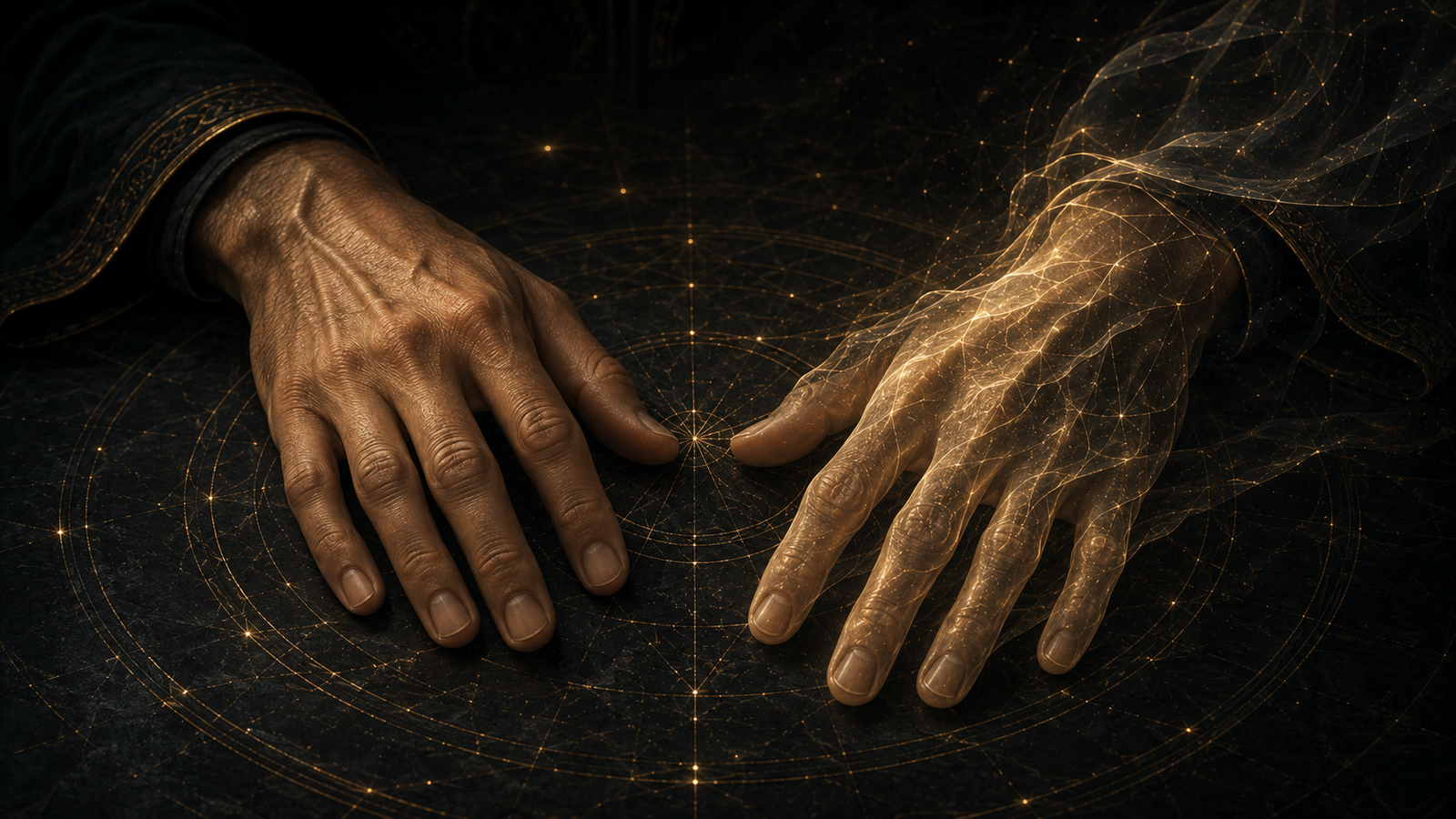
The body is sometimes treated as the lowest part of us.
It aches, hungers, tires, ages, reacts, and interrupts. It refuses to behave like pure thought. A person may feel infinite during meditation, then be pulled back by a stiff neck, an uncomfortable chair, or the need to sleep.
From that contrast comes an old spiritual temptation: consciousness is sacred, while the body is the burden consciousness must escape.
Veilurgy cannot accept that division.
The work involves crossing beyond the limits of the visible world, but it begins in a body and returns to one. The body is not an unfortunate container left behind while the real self travels. It is the form through which another world becomes capable of touching this one.
Formlessness without form cannot leave a footprint here.
The body as proof of limitation
Most of us learn the body first as a boundary.
I am inside this skin. You are outside it. I can reach only as far as my hands extend. I can see from one position at a time. The body appears to establish where the self begins and ends.
The conclusion feels undeniable because it is repeated every day.
Yet awareness does not behave exactly like an object inside a container.
It can fill a room through attention. It can return to a place remembered decades earlier. It can be absorbed by something far beyond physical reach. In dreams, it may occupy a body that moves by different rules, or experience a place that has no obvious relationship to the room in which the physical body lies.
None of this proves a particular theory by itself. Imagination, memory, and dreaming are complex. Still, it should make us cautious about treating the body's visible boundary as a complete definition of consciousness.
Veilurgy begins within that uncertainty.
The body establishes form, but awareness may not be reducible to the form it currently inhabits.
The mistake of rejecting the doorway
If you believe the body blocks spiritual experience, you may begin fighting every sensation that proves you are still here.
Breath becomes a technique to escape rather than a movement to enter. Relaxation becomes a test. Physical discomfort becomes evidence that the meditation failed. The person waits for the body to disappear before anything sacred can happen.
This creates tension around the very state meant to release it.
A doorway does not prevent passage because it has a frame. The frame is what allows us to recognize and cross it.
The body can function in the same way.
Sensation gives attention a place to gather. The rhythm of breathing provides a road away from scattered thought. The hands can become an anchor for belief, not because power is trapped inside them, but because a repeated gesture gives inward intention a form the body remembers.
Mathias's use of his hands belongs in this category. It is a personal anchor, not a universal law. The hands do not possess an independent force that every practitioner must learn to activate. They became meaningful through attention, repetition, and belief.
Another person may find the breath, a word, a posture, a sound, or no physical anchor at all more natural.
The object is not the source.
The body helps belief take shape.
Formlessness is not disappearance
The word formless can suggest blankness.
We imagine becoming a cloud of awareness with no identity, location, or distinction. This may sound peaceful to one person and frightening to another.
In Veilurgy, formlessness is better understood as freedom from the demand that one form be final.
The personality is a form. The body is a form. This world is a form. A thought becomes form when belief gives it shape. None of these must be destroyed in order for something beyond them to exist.
Formlessness is the capacity from which forms arise and into which they can loosen.
Think of water.
It takes the shape of a cup without becoming the cup. Pour it elsewhere and another boundary appears. The form is real, but it does not exhaust the nature of what is being held.
Consciousness may relate to the body in a way that is stranger and less simple than this image, but the principle is useful. To inhabit a form completely does not require believing that the form is all you could ever be.
The body can be honored without being made into the final border of reality.
Listening instead of conquering
Many practices approach the body as something to control.
Sit still. Breathe correctly. Ignore discomfort. Master the senses. Overcome reaction.
Discipline has a place, but conquest is a poor foundation for relationship.
The body carries information. It tells us when a practice has become strained, when attention has drifted into panic, when an experience needs time to settle, and when ordinary needs have been neglected in pursuit of something extraordinary.
Listening does not mean obeying every impulse. It means allowing sensation to participate in the work.
Before meditation, ask:
Where am I bracing?
What am I trying to force?
What does the body expect to happen?
These questions often reveal that doubt is not only a sentence in the mind. It may appear as a held breath, a tightened stomach, a clenched hand, or the feeling of leaning toward a result.
Belief also has a posture.
It may feel less like excitement than the absence of argument. The body stops reaching. The breath moves without supervision. Nothing is missing for a moment.
That moment is worth learning.
The body carries the world home
A crossing that cannot enter the body remains separate from daily life.
It becomes a story about something that happened elsewhere. The person may cherish it, but the old world resumes control because the experience was never given physical residence.
To carry something home, let it affect how you stand, speak, rest, choose, and attend.
This does not require theatrical behavior. A genuine change may be almost invisible. Perhaps you wait before responding. Perhaps you no longer check for signs as often. Perhaps a familiar thought passes without receiving the same bodily obedience.
These are forms.
The unseen has entered the visible through them.
Manifestation is often discussed as the appearance of an external object or circumstance. Veilurgy sees that as only the surface. The earlier manifestation is the moment a state acquires form within the person who will meet the world.
The hands no longer grasp.
The shoulders no longer prepare for the same blow.
The breath no longer asks permission.
The body becomes evidence, not for an audience, but for the self.
A practice of inhabiting form
Stand or sit comfortably.
Bring attention to one hand. Do not imagine energy. Begin only with sensation: temperature, pressure, weight, pulse, and the shape of the fingers.
Then hold one thought:
This form is not the whole of me, but it is wholly mine to inhabit.
Let attention fill the hand without trying to move beyond it. After a minute, extend awareness to the space immediately around the hand. Notice whether the border between sensation and imagined space feels as clean as expected.
Do not force an answer.
Bring attention back into the hand. Move it slowly. Touch an ordinary object and feel its texture.
This small movement contains the structure of Veilurgy:
Form.
Expansion.
Return.
Contact.
The purpose is not to prove that the hand possesses hidden power. It is to learn that awareness can loosen from a boundary and enter it again deliberately.
The body is not a wall standing between you and the worlds beyond.
It is the place from which you approach, and the place to which you bring them back.
Say what you have seen, or ask what you need to ask. I read all of it.