
The Courage to Stop Asking Permission
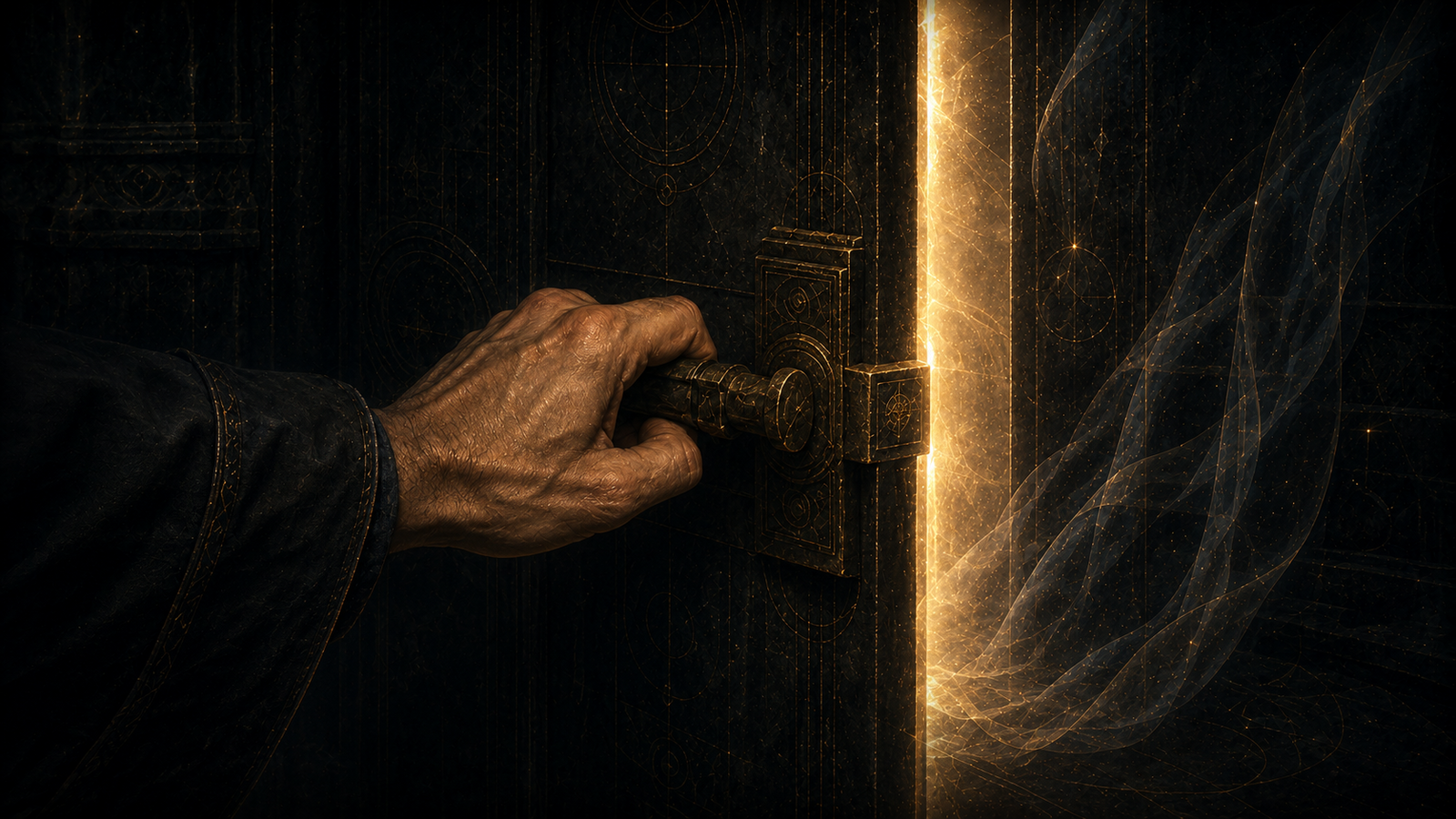
There are questions people do not ask because the room has already answered them.
The answer may be visible in a raised eyebrow, an impatient silence, a title, a reputation, or the unspoken rule that certain people explain while others listen. Nothing explicit has to be said. The person feels the shape of the room and makes themselves smaller inside it.
This is often mistaken for humility.
Sometimes it is simply fear wearing good manners.
Veilurgy is concerned with belief, and belief is revealed in action long before it becomes a spiritual statement. If I continually silence my own question because someone else might judge it, I am practicing a belief about myself.
I am saying:
"My perception needs permission."
"My uncertainty is embarrassing."
"My truth becomes valid only after someone stronger approves it."
These beliefs do not remain inside a single conversation. They become part of the world the mind inhabits.
The authority outside the self
People naturally seek teachers.
Someone who has walked a road can identify turns that a newcomer would miss. A book can preserve years of work. A community can compare experiences and prevent each person from having to begin alone.
Authority becomes dangerous when guidance is confused with ownership.
The teacher describes a road, then quietly becomes the gate. The student stops asking what they perceive and begins asking what they are allowed to perceive. A question is judged according to whether it supports the teaching. Doubt becomes disloyalty.
This structure can appear even without a manipulative teacher. A person may surrender authority willingly because certainty is comforting. It is easier to receive a map than to admit that part of the road remains unknown.
Veilurgy must resist this.
Mathias is not a priest of the veil. No one owns the threshold. The work asks people to join nothing, worship nothing, and hand over no private authority in exchange for access.
A guide can say, "This is what I found."
They cannot honestly say, "Your experience belongs to me now."
The question as an act of validity
A genuine question does more than request information.
It announces that the person asking has noticed a gap and trusts that noticing enough to speak.
This is why some environments discourage questions while claiming to welcome them. The institution wants requests for clarification, not challenges to structure. It permits curiosity as long as curiosity remains obedient.
The self learns quickly.
It begins editing before speaking. It chooses the respectable uncertainty and conceals the dangerous one. Eventually the person may stop hearing their own question at all.
From a Veilurgy perspective, this is a thickening of the veil.
The ordinary world depends heavily upon inherited certainty. It tells us what counts as real, which experiences may be discussed, and which interpretations are permitted. The first movement toward another world is often a question the visible world cannot answer cleanly.
What if awareness is not confined here?
What if a dream was more than a dream?
What if thought is not merely commentary?
What if this is not the only world available?
To ask does not prove the answer. It creates enough space for an answer other than the approved one to become possible.
Permission and manifestation
The search for permission also appears in manifestation practice.
A person feels an intention, then immediately checks whether it is reasonable. Would friends approve? Is it too ambitious? Is there enough evidence? Does someone with greater authority believe it can happen?
Practical judgment matters. We live among consequences, resources, responsibilities, and other people's freedom. But practical judgment is not the same as requesting permission to possess an inner direction.
You are allowed to hold a possibility before the world understands it.
You are allowed to explore a spiritual experience without declaring it proven or dismissing it as foolish.
You are allowed to feel complete for a moment even if circumstances have not yet reflected the state.
Belief that depends upon unanimous approval never becomes belief. It remains a proposal submitted to a committee.
The veil does not grow thin by vote.
The danger of becoming your own censor
External authority eventually becomes internal.
Long after the critical person or restrictive environment is gone, the voice remains. It predicts ridicule, rejection, failure, and embarrassment. It tells us to wait until we can explain everything perfectly.
This voice often sounds responsible.
"Be realistic."
"Do not make a fool of yourself."
"You need more proof."
"Someone more qualified should speak."
Sometimes caution is wise. Not every thought needs an audience. Privacy protects experiences that are still forming. The difference is whether silence is chosen or obeyed.
Chosen silence feels like containment.
Obedient silence feels like disappearance.
One keeps the truth until the proper time.
The other teaches the self that there will never be a proper time.
Speaking without becoming a preacher
Finding your voice does not require making everyone listen.
This is especially important in spiritual work. A person who has been silent for years may discover something meaningful and swing toward the opposite extreme. They begin correcting, persuading, and explaining in every room.
That is still dependence upon the mirror.
The voice now demands an audience in order to feel real.
Inner validity permits a quieter speech:
"This is what I experienced."
"This is how I understand it."
"I may be wrong about part of it."
"You do not have to agree."
These statements are strong because they do not seize authority over the listener.
Veilurgy can be stated plainly. The worlds behind the veil are not presented as metaphor within the teaching. At the same time, no stranger is required to reorganize their reality around that claim.
The ability to speak and the ability to release the outcome belong together.
One unapproved sentence
For the next week, notice every moment when you seek permission unnecessarily.
Do not begin with the largest confrontation in your life. Choose small moments.
Ask the question you almost withheld.
State a preference without building a legal case for it.
Say, "I do not know," when pretending certainty would be more impressive.
Write one private paragraph that begins, "What I have not allowed myself to believe is..."
You do not have to act upon everything you write. The first work is to let the sentence exist without immediate trial.
Then observe the body.
Where does it brace? What consequence does it expect? Whose face appears in the mind?
This is the inherited room.
You may be standing alone while still arranging yourself for its judgment.
Take one breath and let the room be empty.
The purpose is not rebellion for its own sake. It is the restoration of direct relationship with your own perception.
The crossing cannot be performed on your behalf. A teacher can point, warn, describe, and accompany. At the threshold, however, the belief must be yours.
So must the question that brought you there.
Say what you have seen, or ask what you need to ask. I read all of it.